
The Original One-Person Backend
BBS sysops were running platforms from their bedrooms before 'indie hacker' was a word

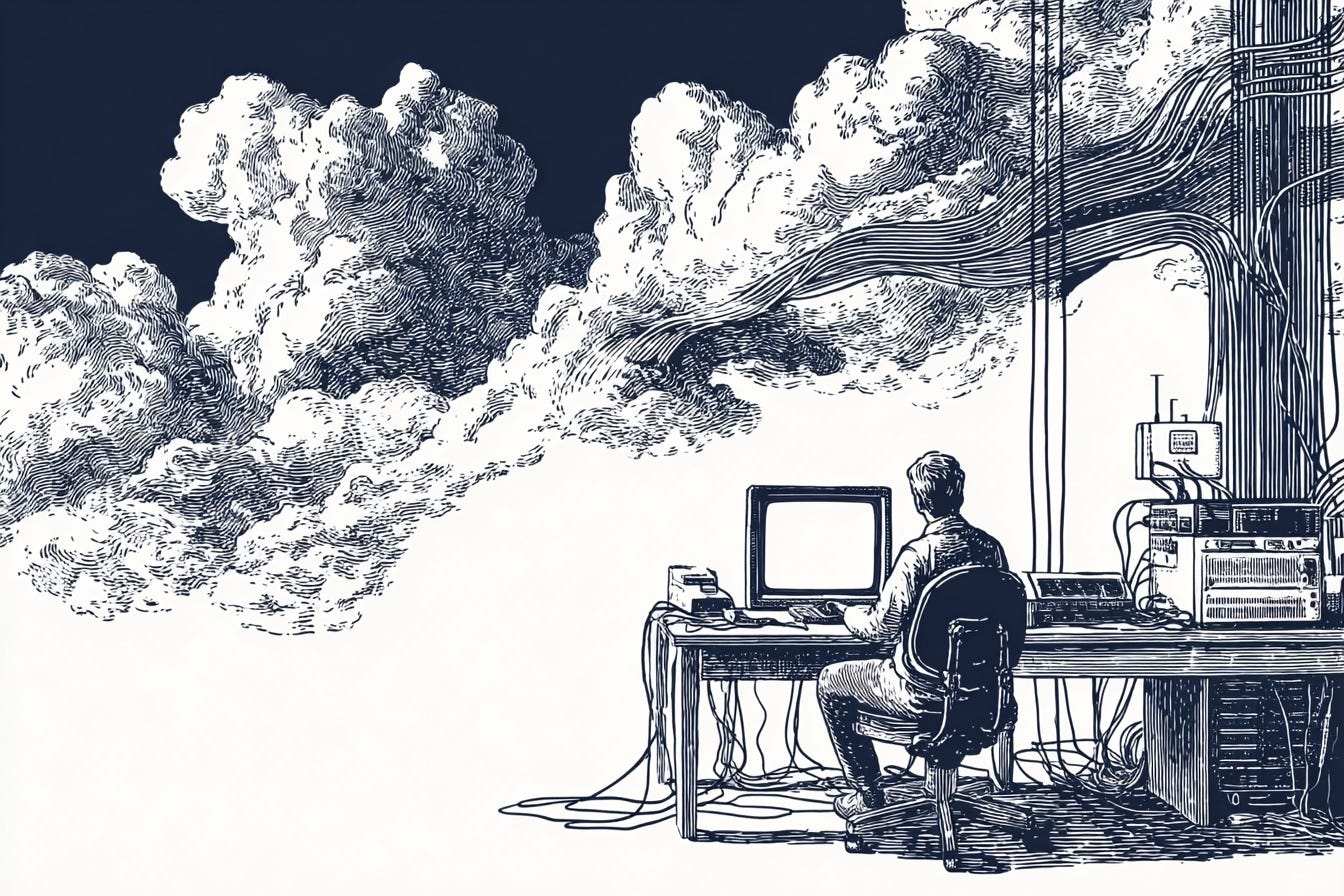
It’s 1991. Somewhere in suburban Ohio, a sixteen-year-old is running an online community from his bedroom. The infrastructure: a 386 with 4MB of RAM, a 40MB hard drive, a 14.4k modem, and a single phone line he shares with his parents. The software: a registered copy of PCBoard, purchased for $149 from Clark Development Company. The community: two hundred users who dial in one at a time, leave messages on forums, upload shareware, and argue about whether OS/2 will kill DOS.
He is the sysop, the system operator. He is also the system administrator, the content moderator, the customer support team, the network engineer, and the janitor. When the hard drive fills up, he decides what gets deleted. When someone posts something offensive, he decides what stays. When the modem drops a connection at 3 AM, he gets out of bed and resets it.
He is running a one-person backend.
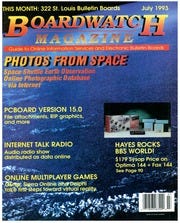
Boardwatch Magazine, July 1993. The trade publication for BBS sysops — this issue covers PCBoard 15.0, Internet Talk Radio, and online multiplayer games. If you ran a bulletin board, this was your industry press.
The BBS Era: One Machine, One Modem, One Person
The bulletin board system era produced a remarkable archetype: a single person operating an entire platform. Not a website. Not an app. A platform — with user accounts, file storage, messaging, forums, real-time chat (if you were lucky enough to have multi-node), and an economy built on upload/download ratios and access levels.
The constraints were brutal and physical. One phone line meant one user at a time. Your storage was measured in megabytes. Your bandwidth was measured in baud. Every decision was a tradeoff: more file storage meant fewer message boards. More users meant your parents couldn’t make phone calls. Going multi-line meant a second modem, a second phone line, and a copy of Desqview to fake multitasking on a machine that couldn’t actually do it.
And yet — BBS Magazine, writing in 1995, captured it perfectly: “Running a BBS is no bed of roses. BBSs cost time and money, and they’ll always cost you more time and money than you thought they would.” The magazine then advised prospective sysops to double their estimates. Sound familiar? Every founder who ever scoped a side project is nodding right now.
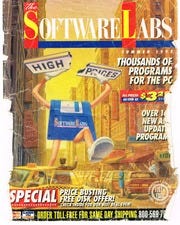
The Software Labs catalog, Summer 1993. “Thousands of Programs for the PC” starting at $3. This was the app store before app stores — solo developers mailed in their shareware and hoped someone flipped to the right page.
What made the BBS sysop remarkable wasn’t the technology. It was the scope of operation. A single person was simultaneously:
Platform operator — keeping the hardware running, the software configured, the phone line active
Community manager — setting access levels, moderating discussions, banning troublemakers
Content curator — organizing file areas, maintaining download libraries, writing bulletins
Commerce operator — many BBS operators charged subscription fees, sold access levels, or ran “subscription BBSes” as small businesses
Network engineer — configuring FidoNet echomail, scheduling nightly mail transfers, managing node numbers
Clark Development’s PCBoard even shipped with its own programming language — PPL — so sysops could write custom door games, automate moderation, and extend the platform. A sysop who learned PPL was, in modern terms, a solo developer shipping features on their own platform.

The PCBoard Programming Language (PPL) Reference Manual. Clark Development shipped a full scripting language with their BBS software. If this image looks barely legible — that’s era-appropriate. Most of these manuals didn’t survive.
The shareware ecosystem that orbited the BBS world was its own universe of one-person companies. A developer in Michigan would write a ZIP file utility, package it with a FILE_ID.DIZ description file, upload it to a few BBSes, and watch it propagate through the network. The Software Labs catalog from 1993 listed thousands of shareware titles — each one representing a solo developer or tiny team who built something, priced it at $15-$40, and distributed it through a network of bulletin boards and mail-order catalogs. No app store. No payment processor. Just a PO Box and an honor system.
The Web Era: GeoCities to LAMP Stack
The web didn’t kill the one-person operator. It scaled them.
GeoCities, launched in 1994, gave millions of people their first taste of running their own corner of the internet. No modem configuration, no phone line dedication, no hardware maintenance. Just HTML in a text editor and a free hosting account organized into “neighborhoods” — SiliconValley for tech, Hollywood for entertainment, Area51 for the weird stuff.
The GeoCities webmaster was the BBS sysop’s direct descendant. Same impulse: I want to run my own thing. Same scope: content, community (via guestbooks), commerce (via PayPal donate buttons and, later, Google AdSense). Different tools, identical archetype.
Then came the LAMP stack, and the one-person operator leveled up dramatically. Linux, Apache, MySQL, PHP — running on a $20/month shared hosting account — gave a single developer more capability than an entire BBS network. You could build a forum (phpBB), a blog (WordPress), a wiki (MediaWiki), a storefront (osCommerce), and an email list (PHPList). All on one box. All as one person.
The CGI-bin era deserves its own mention. Perl scripts with .cgi extensions, running on shared hosting, processing form submissions and writing to flat files. It was ugly. It was insecure. It was incredibly empowering. A single developer with a copy of “Programming Perl” and an FTP client could build interactive web applications years before Rails or Django existed.
The Indie Hacker Era: Stripe + Heroku + AWS
Around 2010, something shifted. The tools didn’t just get better — they got composable. Stripe meant a solo developer could process payments without a merchant account. Heroku meant deploying a web app without configuring a server. AWS meant scaling without buying hardware. Twilio meant sending SMS without negotiating with carriers.
The “indie hacker” emerged as a recognized archetype. People like Pieter Levels building Nomad List. Patrick McKenzie writing about running a one-person SaaS. The Indie Hackers community turning solo development into a movement with its own vocabulary: MRR, ramen profitability, bootstrapping.
But here’s the thing nobody said out loud: this wasn’t new. The indie hacker was the BBS sysop with better tools. The impulse was identical — I want to build and run the whole thing myself. The constraints had changed (no more phone lines to manage, but now you had AWS bills to optimize), and the ceiling had risen (a one-person SaaS could serve thousands of concurrent users, not one at a time), but the person was the same.
Someone who wanted to own the entire stack. Someone who found the tradeoffs energizing rather than exhausting. Someone who would rather learn DevOps at 2 AM than hire a DevOps person.
Now: The Most Powerful Solo Operator Stack in History
Today’s solo developer has access to infrastructure that would have been inconceivable at every previous stage:
Serverless compute (Lambda, Cloudflare Workers) — no servers to manage, pay per invocation
Edge databases (Turso, D1, Neon) — data at the edge, globally distributed, pennies per million reads
Embedded auth (Clerk, Auth0, Supabase Auth) — user management as a dependency, not a project
AI agents — not just tools but teammates, capable of writing code, handling support, generating content, managing deployments
The leap from “14.4k modem and PCBoard” to “Cloudflare Workers and an AI agent fleet” is enormous in capability and essentially zero in architecture. It’s still one person, one machine (a laptop instead of a 386), one stack that they understand end-to-end.
The BBS sysop’s hard drive held 40 megabytes. A Cloudflare Worker can access a D1 database with 10 gigabytes of storage at the edge, globally. The sysop served one user at a time. A serverless function handles thousands concurrently. The sysop wrote PPL scripts to automate moderation. Today’s solo dev deploys AI agents that handle customer support, triage issues, and write documentation.
The ratio has changed. The archetype hasn’t.
The Pattern
Every generation of tooling does the same thing: it raises the ceiling on what one person can operate alone.
BBS (1983-1995) — PC + modem + PCBoard. One user per line. The hard part: hardware, phone lines, physical limits.
Early Web (1995-2005) — LAMP on shared hosting. Hundreds of concurrent users. The hard part: sysadmin, security, scaling.
Indie SaaS (2010-2020) — Heroku + Stripe + AWS. Thousands concurrent. The hard part: ops complexity, vendor management.
AI-native (2024+) — Edge + serverless + AI agents. Unlimited concurrent. The hard part: taste, direction, knowing what to build.
The hard part migrates up the stack with every generation. BBS sysops fought physics. Early web developers fought servers. Indie hackers fought operational complexity. Today’s solo dev fights... the paradox of too much capability and not enough clarity on what to build.
The constraint is no longer technical. It’s editorial. What do you build when you can build anything? What do you automate when you can automate everything? The sysop who carefully curated their file areas — deciding which shareware deserved disk space on a 40MB drive — was exercising the same judgment that today’s solo dev exercises when deciding which AI agent to deploy and which feature to ship.
What the Sysops Would Think

Jason Scott during the filming of BBS: The Documentary (2005). He spent three years interviewing hundreds of former sysops — the people who ran entire platforms from their bedrooms before the web existed.
Jason Scott spent three years making BBS: The Documentary, interviewing hundreds of former sysops. What comes through in every interview is a specific personality type: someone who was compelled to run the whole thing. Not because it was efficient. Not because it was profitable. Because the act of operating a complete system — from hardware to community — was itself the point.
A BBS sysop from 1991, transported to 2026, would understand today’s solo dev stack instantly. Not the technology — the motivation. You mean I can run a platform that serves the entire world, from my laptop, with no phone line bills? You mean the software writes itself now? You mean I don’t have to get out of bed to reset the modem?
They’d be confused by the technology and completely at home with the ambition.
Because the original one-person backend wasn’t a technology choice. It was a personality type. And that type — the person who wants to build and operate the whole thing, who finds the sprawl energizing rather than overwhelming, who’d rather understand every layer than delegate any of them — that type has been building since the first BBS went online in Chicago in 1978.
The tools got better. The person stayed the same.
The Undercurrent covers solo dev infrastructure, opinionated architecture, and the tools that make one-person teams possible. Subscribe at theundercurrent.dev.